


Virtual Production, Film Technology for UK Brands
Until recently, if you wanted your brand film to open on a vast Icelandic glacier, a futuristic cityscape, or the interior of a spacecraft, you had two options: spend significantly on location travel and logistics, or spend significantly on post-production visual effects. Neither was accessible to most UK businesses outside of the largest advertising budgets. Virtual production changes that calculation substantially.
The technology that drove the visual language of productions like The Mandalorian and a growing number of high-profile UK commercials is now available to brands at a range of budget levels. Understanding what it is, how it works, and where it genuinely adds value is increasingly useful knowledge for any business commissioning ambitious video content.
What Virtual Production Actually Is
Virtual production is a broad term, but at its core it refers to a filmmaking methodology that uses real-time computer graphics, rendered live rather than in post-production as an active part of the production process rather than something added afterwards.
The most visually striking application of this is the LED volume: a large, curved screen (and often a ceiling screen) surrounding the studio set, displaying photorealistic backgrounds generated and rendered in real time by game engine technology, most commonly Unreal Engine. Cameras track the movement of the lens in real-time, adjusting the perspective of the background to match - creating a parallax effect that makes the digital environment appear genuinely three-dimensional and physically present rather than flat.
The result is that actors and objects filmed in front of an LED volume appear to exist within the digital environment with accurate lighting from the screen, physically correct reflections and shadows, and a sense of presence that green screen compositing struggles to replicate.
How It Differs From Green Screen
The comparison with green screen, the established method for placing subjects against digital backgrounds -is the most useful starting point for understanding what virtual production offers.
Virtual Production (LED Volume)
✓Accurate environmental lighting on subjects from the screen itself
✓Real reflections and interactive light on cars, glass, chrome surfaces
✓Actors can see and react to the environment they're in
✓Final look visible on set for minimal clean up in post
✗Higher day rate for studio and tech setup
✗Background must be built in 3D before shoot
Traditional Green Screen
✓Lower studio cost per shoot day
✓More flexibility to change backgrounds in post
✗Lighting on subjects must be matched to background in post - complex and costly
✗No interactive light, reflections must be added manually
✗Actors cannot see the environment, harder performances
✗Final look unknown until post, revisions expensive
The short version: green screen is cheaper to shoot and more flexible to change, but more expensive and time-consuming to finish convincingly. Virtual production costs more on set but delivers a more photorealistic result with significantly less post-production complexity, and for content where quality of integration matters, that trade-off is often clearly worthwhile.
Where Virtual Production Makes Commercial Sense for UK Brands
Not every project benefits from virtual production, and a good agency should be honest about where it adds genuine value versus where it's a solution looking for a problem. Here are the use cases where the technology consistently earns its place.
Automotive advertising
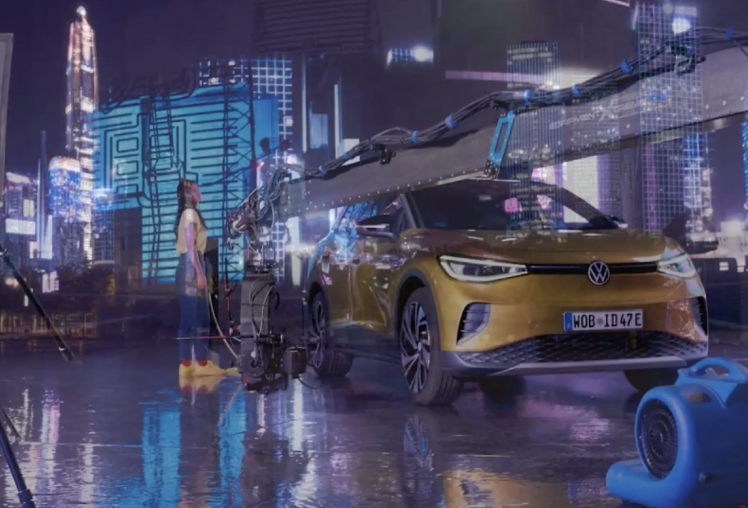
Cars are one of virtual production's most compelling applications. The interactive lighting from the LED volume creates accurate, beautiful reflections across bodywork, glass, and chrome, something green screen compositing has always struggled to achieve convincingly. A car filmed in front of a high-quality LED environment with a well-lit studio can look indistinguishable from location footage at a fraction of the logistics cost.
Brand films requiring dramatic or inaccessible environments
Snowscapes, deserts, period architecture, futuristic cities, open ocean, environments that would require significant international travel or elaborate physical construction are buildable digitally and displayed on an LED volume at a cost that is frequently lower than the travel and logistics alternative, particularly for UK brands operating with realistic production budgets.
High-end product launches
For brands launching premium products where visual environment is central to the perceived value of the item - luxury goods, technology products, high-specification equipment, virtual production allows precise control over the environment and lighting in a way that is difficult to achieve reliably on location, where weather, logistics, and unpredictable variables introduce risk into high-stakes shoots.
Broadcast content with frequent background variation
For TV productions, series content, or multi-episode branded content requiring different visual environments across episodes, virtual production can significantly reduce the cumulative location cost - backgrounds can be changed between setups at the cost of the 3D environment build rather than a new location recce, travel, and logistical deployment.
Where Virtual Production Is the Wrong Choice
As with any technology, the temptation to apply it beyond its optimal use cases is real. Virtual production is not the right choice for:
- Content where authentic location texture is the point - a documentary about a community, a brand film rooted in a specific place, content where the reality of the environment contributes directly to credibility and emotional resonance. A photorealistic digital recreation of a factory is not the same thing as filming in one.
- Projects where the budget doesn't support the technology - virtual production has a meaningful minimum cost floor. Below a certain budget threshold, the technology adds more cost than value, and simpler solutions serve the objective better.
- Fast-turnaround social content - the pre-production time required to build high-quality 3D environments doesn't suit the agile, rapid production cadence of most social media content strategies.
What Virtual Production Costs in the UK
Cost varies significantly based on the scale of the LED volume, the complexity of the 3D environments required, and the overall production scope. As a general guide for UK productions:
- LED volume studio hire: £3,000 - £15,000 per day depending on volume size and location
- 3D environment build: £5,000 - £30,000+ depending on complexity and realism required
- Technical crew (Unreal Engine operator, real-time technician): £1,500 - £4,000 per day
- Full virtual production project (including pre-production, shoot, and post): £25,000 - £120,000+ depending on scope
These figures need to be weighed against the alternative - the cost of achieving a comparable result through international location shooting or extensive post-production VFX work, which for ambitious creative briefs can frequently exceed the virtual production equivalent.
The right question isn't "is virtual production expensive?" It's "is virtual production the most cost-effective way to achieve what this brief needs?" For the right project, the answer is often yes.
What to Look for in a Virtual Production Partner
Virtual production is a technically complex discipline that combines filmmaking craft with game engine expertise, real-time rendering, and specialist studio infrastructure. When evaluating agencies or production companies for a virtual production project, look for:
- Demonstrated experience with LED volume shoots - ask to see examples of completed work, not just technical capability claims
- In-house Unreal Engine or equivalent expertise, or established partnerships with technical specialists
- A pre-production process that includes thorough environment design and technical testing before the shoot day
- Honest assessment of where virtual production adds value on your specific brief versus where simpler approaches would serve you better
Interested in what virtual production could do for your next project? At Horizon Collective, we have virtual production partners to help UK brands achieve cinematic ambition at realistic budgets. If you have a project in mind or just want to understand what's possible, get in touch and let's talk through it.
FAQs
What is an LED volume in virtual production?
An LED volume is a large curved display, sometimes wrapping 270° around a studio set, often including a ceiling screen, that shows photorealistic digital environments rendered in real time. The camera tracks the movement of the lens and adjusts the on-screen perspective to match, creating a three-dimensional parallax effect that makes the digital background appear physically present. The screen also provides accurate environmental lighting on the subjects and objects being filmed, which is the key quality advantage over green screen compositing.
Is virtual production only for large Hollywood productions?
No longer. While the technology originated in high-budget feature film and major television production, the infrastructure has expanded significantly in the UK over the past several years, with LED volume facilities now accessible at a range of scales and price points. Brands with mid-range production budgets can now access virtual production for specific projects where it genuinely adds value, without the costs associated with the largest Hollywood-scale volumes.
How long does it take to prepare a virtual production shoot?
Preparation time is significantly longer than a conventional studio shoot. Building the 3D environments, testing them on the volume, calibrating the camera tracking system, and completing technical rehearsals typically requires four to eight weeks of pre-production before the shoot day. This pre-production investment is front-loaded - it replaces the post-production complexity that a conventional shoot would generate, but it needs to be factored into project timelines from the outset.
Can virtual production be used for live events or streaming?
Yes and this is one of the most rapidly developing applications of the technology. Real-time rendering and LED volume environments can be used for live broadcast, virtual events, and streaming productions, providing dynamic, high-quality visual environments without the logistics of physical location deployment. The technical setup is more complex than a standard virtual production shoot, but the capability exists and is increasingly being used for broadcast and live event contexts in the UK.


